Baptismal Candles FAQ
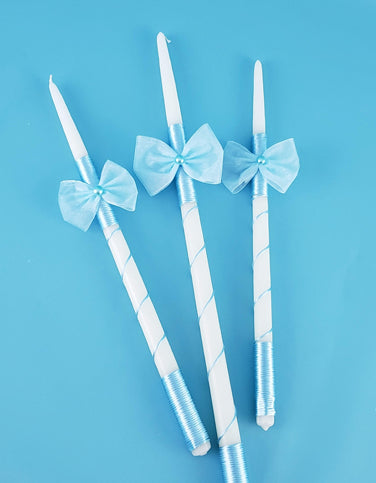
What are baptismal candles? Baptismal Candles are central to the baptismal ceremony. They usually include one large decorated white candle for the ceremony and two or more smaller white candles to be carried by the children who circle the font.
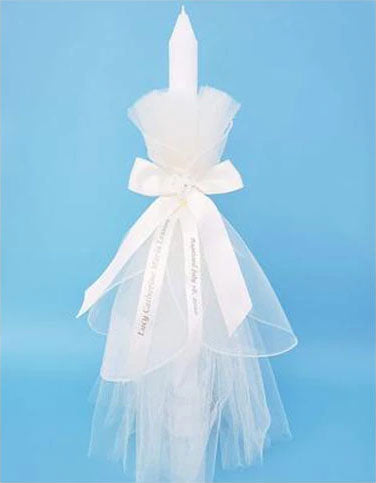
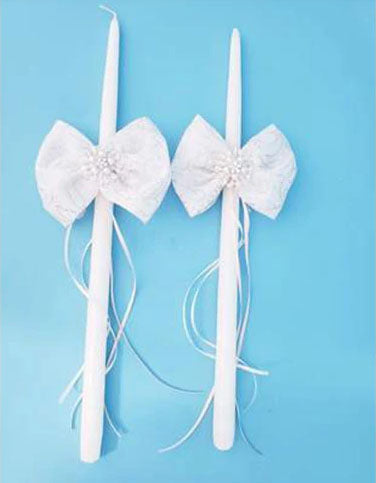
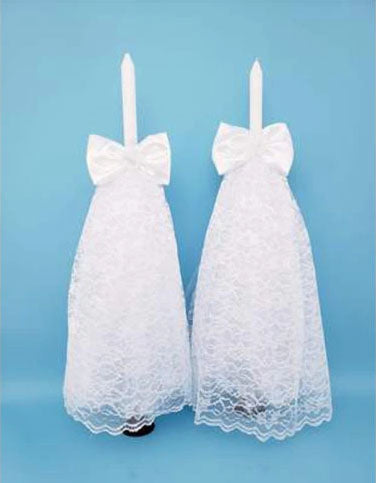
What is the typical baptismal candle? The traditional decoration of a baptismal candle includes a large bow of ribbon or tulle with streamer. The candle is usually 24 inches to 33" inches in height, however, may be any length of the Godparents’ choosing.
When are the candles used during a baptism? The use of the candles comes into play during the ceremony after the Sacrament of Baptism. While the baby is dressed into his or her new baptismal clothing in a side room of the church, the children who are invited to participate in the ceremony are called up to the altar and given their baptismal candle to hold. Traditionally, 1 to 5 children participate. Children's candles are typically smaller and more basic in decoration than the main baby’s baptismal candle.
When the baby returns to the altar, the decorated baptismal candle is lit. The priest, the godparent holding the infant and a few selected children walk around the font three full times - symbolizing a dance of celebration for the baby who has newly entered into the church. The main decorated candle is held by the second Godparent (if there is one), the Godparent, or a parent of the child.
After the baptism: What do I do with the baptism candle? The
godparents must bring the baptized baby to church for three communions
after the baptism. Ideally, these communions are taken
consecutively the first three Sundays after the baptism.
If the Godparent(s) or Godchild is not available for a particular
Sunday, then communion should be taken the next available Sunday.
The
baptismal candle is brought with the Godchild to the church each of
these three communions. A few minutes before communion starts, the
Godparent should light the candle using the flame from a lit candle in
the narthex. The lit candle should be brought up to the alter during
communion. It may be blown out at any point after communion. Special
note: the Godparent should carry the child on the right side of his or
her body as he/she approaches the alter. If there are two Godparents,
one should carry the baby to the alter, the other should hold the lit
candle. At the time of communion, the Godparent should provide the
priest wtih the baptismal name of the baby right before the baby accepts
communion.
*******
Other Baptism FAQ
Preparing for the Ceremony - What Items are needed? - Baptismal Candles
Provided by the godparent, one large decorated candle for the
ceremony and smaller white candles to be carried by the children who
circle the font. The traditional decoration of a baptismal candle
includes a large bow of ribbon or tulle with streamers.
- Martyrika
Also known as martirika, or witness pins – these are small
lapel crosses handed out at the end of the ceremony and worn by guests
as proof of witnessing the baptism. The traditional pin is made of
white, pink or blue ribbon and features a tiny cross or icon in the
center.
- Bombonieres
Also known as boubounieres or candy favors – are almond candy
favors given to each guest after the baptism by either the godparent or
the parents of the baptized child. Styles can range widely for these
favors. Traditional favors are simple white, pink or blue puffs of tulle
tied with a ribbon and filled with white Jordan almonds. However,
styles can range widely and can extend to the elaborate, distinctive and
fun.
The gift of bombonieres is an Eastern Orthodox tradition over 3,000
years old. Filled with koufeta – jordan almonds – the favors are given
as tokens of good fortune and happiness. Bombonieres are symobolic of
life with their bittersweet taste. The sugar coating represents the
hope that life will be blessed with more sweetness than bitterness.
Bombonieres are always filled with an odd number of almonds. The odd
number is indivisible and symbolizes the union and indivisibility of the
newly married couple.
- Additional Items Needed -- 2 white hand towels
-- 1 large white bath towel for wrapping the child
-- 1 white sheet
-- 1 bar of soap
-- 1 small bottle of olive oil
-- 1 baptismal cross and chain (traditionally a gold cross)
-- Proof of current good standing in the Orthodox church -- A new change of clothes for the child after Baptism. All clothing should be white.
What dates are baptisms not permitted? Baptisms may
not be conducted on the following days unless it is absolutely necessary
and permission is obtained from the Metropolis Metropolitan: 1.
December 25th - January 6th 2. Holy Week 3. Major Feast Days 4.
August 1-15
What are bouboniera?
Bouboniera are favors given out in celebration at weddings, baptisms,
anniversaries, and any special celebratory event. The favors
traditionally contain jordan almonds. Boubonieres are given out as
gifts to each guest after the wedding or
baptism at the reception. Styles can range widely for these favors.
Traditional favors are simple
white, ivory, pink or blue puffs of tulle tied with a ribbon. However,
styles
can range widely and can extend to the elaborate, distinctive and fun.
What is the tradition of the favors?
The gift of bomboniera is an Eastern Orthodox tradition over 3,000
years old. Filled with koufeta – or jordan almonds – the favors are
given as tokens of good fortune and happiness. Bombonieres are
symobolic of life with their bittersweet taste. The sugar coating
represents the hope that life will be blessed with more sweetness than
bitterness.
How many jordan almonds do boubouniera contain?
Bombonieres are always filled with an odd number of almonds. The
odd
number is indivisible and symbolizes the union and indivisibility of the
newly married couple - or the union of the baptized child with his
Godparents. Bouboniera must contain at least 5 almonds - with the 5
almonds representing (1) health (2) happiness, (3) fertility, (4) wealth
and (5) a long life together.
Do you offer other colors besides white for your jordan almonds? Yes!
We also offer pink, light blue and ivory jordan almonds. You can
substitute these colors in your bouboniera if you wish - at no extra
charge. To do so, you may request this option in the comment box at
checkout. We do also offer silver colored jordan almonds (these are
silver foiled wrapped) at an additional charge. If you would prefer
silver colored almonds in your favors, the additional surcharge is $0.85
per favor.
When are favors given out and how many should I order?
Traditionally one favor is given to each guest. For both baptisms and
weddings, the favors are usually given out at the reception (although
sometimes given out directly at the church after a baptism). For
weddings, they may be placed out at the table settings, distributed at
the end of the night, placed out along with table assignments, or given
out by the bride and groom. For baptisms, they may also be distributed
to guests by the Godparents or the parents of the baptized baby.
What's the correct spelling and how do you pronounce bouboniera?
Traditionally pronounced: "Boo-bon-yera" or "Bom-bon-yera". There is
no one correct way to spell this word - you will likely encounter a
variety of spellings. Some of the most popular are: Boubouniera, bouboniera (singular or plural) Boubounieres (plural) Bonboniere, bomboniere (singular) Bomboniera, Bombonieres ... the list goes on.
Who Pays for What for a Baptism? There
is no absolute for whom pays for what, but we can offer general
guidelines on what is traditionally done. Each situation is unique. As
a base foundation, the Godparent assumes the financial responsibilities
of the baptism until the parents of the baptized child offer to pay for
specific items.
The Godparent traditionally pays for/provides: - the baptismal outfit (gown or suit). - The oil & towel set (lathopana) which includes the oil bottle, oil sheet, and baptismal towels. -
The ladopana / baptismal candles – traditionally one large one (one is
adequate for either 1 or 2 Godparents) and 2 smaller candles for any
children or other participants who may be up at the alter. - A gold cross for the child to keep for his/her lifetime. - Martyrika / witness pins. (Some parents of the child offer to pay for this.) - Jordan almond/boubouniera favors. (Some parents of the child offer to pay for this.)
The parents of the child typically pay for: - The reception after the baptism. -
Any gratuities to the priest or any charge for use of a church facility
(although this traditionally is a responsibility of the godparents, many parents of the child nowadays assume this responsibility).
After the baptism: What do I do with the baptismal clothing? Can I wash it? After
the baptism, the baptismal clothes - or vaftistika / baptistika -
contain Holy Oil on the garment. As such, the Holy Oil can not be
disposed of through a washing in a washing machine. The best way to
wash the garment post Sacrament is to do a wash by hand in a bucket.
You can wash the clothing with regular detergent in a bucket and poor
the washed water outside onto the ground. Another option used in
today's more modern times is to wash the garment in a washing machine
but move the drain tube to empty into a bucket (rather than into a sink)
and then dispose of the washing machine water onto the ground of the
Godchild's home. You can also wash the Lathopana (towels and oil
sheet) the same way as these, too, contain Holy Oil on them.
Blessed Celebration: Phone: 201-444-0200 (Mon-Fri: 9AM-6PM, Sat 10AM-5PM)
Email: info@blessedcelebration.com (7 days a week, 9AM-9PM )
|